
Announcement FlightDelay DApp: one of the first full-fledged business applications is live on mainnet:
Great announce:
The FlightDelay DApp https://fdd.etherisc.com is finally online on mainnet. For a detailed description see here: http://medium.com/@skarpischek/youll-love-to-be-late-for-devcon-two-e711bbe750c0#.bffjjtq0g . The DApp is one of the first examples of upcoming business applications on the ethereum blockchain. Powered by one of the most complex contracts on the chain, the FlightDelay DApp manages autonomously the whole business process from application for a policy, underwriting and acceptance, automatic detection of delayed flights and subsequent automatic payout minutes after the arrival. We are very proud to present this application, which shows the power and expressiveness of solidity smart contracts as well as the interaction between different solutions on the blockchain. We are closely interacting with www.oraclize.it, who are providing us with proven and tamper-free flight data from our datasource, flightstats.com. We are using the great www.metamask.io in-browser-wallet solution, alternatively you can run our DApp in the Mist browser.
We invite everybody to investigate our contract, which is verified on etherscan.io and ether.camp, as well as on github (the links can be found in the medium post).
This is no commercial offer, but merely an experiment to show what can be done on the ethereum blockchain. We have provided some funds to ensure that all claims can actually be paid out, but we do not want to make profit (at least at the moment). Therefore, all surplus from the operation of this limited contract will be dedicated to the Ethereum Foundation.
We will be on DevCon2 and happy to see many of you there!
Here is the flight search screen from the FlightDelay website viewed using the Ethereum Wallet in Mist mode:

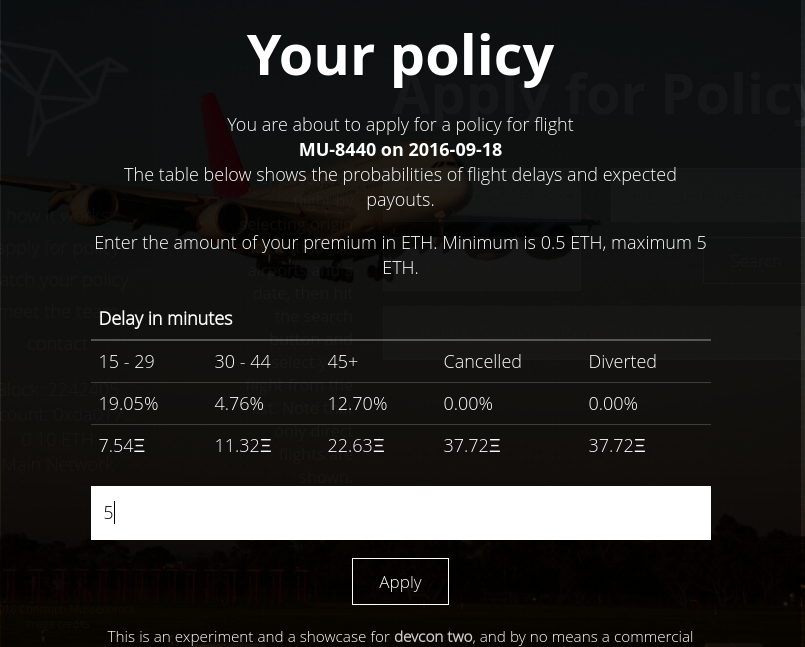
And here are the calculated premiums for the flight insurance:
 .
.
Here’s a different site that seems to be planning to offer flight insurance paid in GBP, BTC and ETH – http://insureth.mkvd.net/.
Update Oct 01 2016
Flight Delay Dapp – lessons learned
FlightDelay Source Code
Following is the verified source code for the FlightDelay smart contract published at 0x4d54be5a62f5d9fcf4b17c7ab6e68822c142ec6b:
|
1 2 3 4 5 6 7 8 9 10 11 12 13 14 15 16 17 18 19 20 21 22 23 24 25 26 27 28 29 30 31 32 33 34 35 36 37 38 39 40 41 42 43 44 45 46 47 48 49 50 51 52 53 54 55 56 57 58 59 60 61 62 63 64 65 66 67 68 69 70 71 72 73 74 75 76 77 78 79 80 81 82 83 84 85 86 87 88 89 90 91 92 93 94 95 96 97 98 99 100 101 102 103 104 105 106 107 108 109 110 111 112 113 114 115 116 117 118 119 120 121 122 123 124 125 126 127 128 129 130 131 132 133 134 135 136 137 138 139 140 141 142 143 144 145 146 147 148 149 150 151 152 153 154 155 156 157 158 159 160 161 162 163 164 165 166 167 168 169 170 171 172 173 174 175 176 177 178 179 180 181 182 183 184 185 186 187 188 189 190 191 192 193 194 195 196 197 198 199 200 201 202 203 204 205 206 207 208 209 210 211 212 213 214 215 216 217 218 219 220 221 222 223 224 225 226 227 228 229 230 231 232 233 234 235 236 237 238 239 240 241 242 243 244 245 246 247 248 249 250 251 252 253 254 255 256 257 258 259 260 261 262 263 264 265 266 267 268 269 270 271 272 273 274 275 276 277 278 279 280 281 282 283 284 285 286 287 288 289 290 291 292 293 294 295 296 297 298 299 300 301 302 303 304 305 306 307 308 309 310 311 312 313 314 315 316 317 318 319 320 321 322 323 324 325 326 327 328 329 330 331 332 333 334 335 336 337 338 339 340 341 342 343 344 345 346 347 348 349 350 351 352 353 354 355 356 357 358 359 360 361 362 363 364 365 366 367 368 369 370 371 372 373 374 375 376 377 378 379 380 381 382 383 384 385 386 387 388 389 390 391 392 393 394 395 396 397 398 399 400 401 402 403 404 405 406 407 408 409 410 411 412 413 414 415 416 417 418 419 420 421 422 423 424 425 426 427 428 429 430 431 432 433 434 435 436 437 438 439 440 441 442 443 444 445 446 447 448 449 450 451 452 453 454 455 456 457 458 459 460 461 462 463 464 465 466 467 468 469 470 471 472 473 474 475 476 477 478 479 480 481 482 483 484 485 486 487 488 489 490 491 492 493 494 495 496 497 498 499 500 501 502 503 504 505 506 507 508 509 510 511 512 513 514 515 516 517 518 519 520 521 522 523 524 525 526 527 528 529 530 531 532 533 534 535 536 537 538 539 540 541 542 543 544 545 546 547 548 549 550 551 552 553 554 555 556 557 558 559 560 561 562 563 564 565 566 567 568 569 570 571 572 573 574 575 576 577 578 579 580 581 582 583 584 585 586 587 588 589 590 591 592 593 594 595 596 597 598 599 600 601 602 603 604 605 606 607 608 609 610 611 612 613 614 615 616 617 618 619 620 621 622 623 624 625 626 627 628 629 630 631 632 633 634 635 636 637 638 639 640 641 642 643 644 645 646 647 648 649 650 651 652 653 654 655 656 657 658 659 660 661 662 663 664 665 666 667 668 669 670 671 672 673 674 675 676 677 678 679 680 681 682 683 684 685 686 687 688 689 690 691 692 693 694 695 696 697 698 699 700 701 702 703 704 705 706 707 708 709 710 711 712 713 714 715 716 717 718 719 720 721 722 723 724 725 726 727 728 729 730 731 732 733 734 735 736 737 738 739 740 741 742 743 744 745 746 747 748 749 750 751 752 753 754 755 756 757 758 759 760 761 762 763 764 765 766 767 768 769 770 771 772 773 774 775 776 777 778 779 780 781 782 783 784 785 786 787 788 789 790 791 792 793 794 795 796 797 798 799 800 801 802 803 804 805 806 807 808 809 810 811 812 813 814 815 816 817 818 819 820 821 822 823 824 825 826 827 828 829 830 831 832 833 834 835 836 837 838 839 840 841 842 843 844 845 846 847 848 849 850 851 852 853 854 855 856 857 858 859 860 861 862 863 864 865 866 867 868 869 870 871 872 873 874 875 876 877 878 879 880 881 882 883 884 885 886 887 888 889 890 891 892 893 894 895 896 897 898 899 900 901 902 903 904 905 906 907 908 909 910 911 912 913 914 915 916 917 918 919 920 921 922 923 924 925 926 927 928 929 930 931 932 933 934 935 936 937 938 939 940 941 942 943 944 945 946 947 948 949 950 951 952 953 954 955 956 957 958 959 960 961 962 963 964 965 966 967 968 969 970 971 972 973 974 975 976 977 978 979 980 981 982 983 984 985 986 987 988 989 990 991 992 993 994 995 996 997 998 999 1000 1001 1002 1003 1004 1005 1006 1007 1008 1009 1010 1011 1012 1013 1014 1015 1016 1017 1018 1019 1020 1021 1022 1023 1024 1025 1026 1027 1028 1029 1030 1031 1032 1033 1034 1035 1036 1037 1038 1039 1040 1041 1042 1043 1044 1045 1046 1047 1048 1049 1050 1051 1052 1053 1054 1055 1056 1057 1058 1059 1060 1061 1062 1063 1064 1065 1066 1067 1068 1069 1070 1071 1072 1073 1074 1075 1076 1077 1078 1079 1080 1081 1082 1083 1084 1085 1086 1087 1088 1089 1090 1091 1092 1093 1094 1095 1096 1097 1098 1099 1100 1101 1102 1103 1104 1105 1106 1107 1108 1109 1110 1111 1112 1113 1114 1115 1116 1117 1118 1119 1120 1121 1122 1123 1124 1125 1126 1127 1128 1129 1130 1131 1132 1133 1134 1135 1136 1137 1138 1139 1140 1141 1142 1143 1144 1145 1146 1147 1148 1149 1150 1151 1152 1153 1154 1155 1156 1157 1158 1159 1160 1161 1162 1163 1164 1165 1166 1167 1168 1169 1170 1171 1172 1173 1174 1175 1176 1177 1178 1179 1180 1181 1182 1183 1184 1185 1186 1187 1188 1189 1190 1191 1192 1193 1194 1195 1196 1197 1198 1199 1200 1201 1202 1203 1204 1205 1206 1207 1208 1209 1210 1211 1212 1213 1214 1215 1216 1217 1218 1219 1220 1221 1222 1223 1224 1225 1226 1227 1228 1229 1230 1231 1232 1233 1234 1235 1236 1237 1238 1239 1240 1241 1242 1243 1244 1245 1246 1247 1248 1249 1250 1251 1252 1253 1254 1255 1256 1257 1258 1259 1260 1261 1262 1263 1264 1265 1266 1267 1268 1269 1270 1271 1272 1273 1274 1275 1276 1277 1278 1279 1280 1281 1282 1283 1284 1285 1286 1287 1288 1289 1290 1291 1292 1293 1294 1295 1296 1297 1298 1299 1300 1301 1302 1303 1304 1305 1306 1307 1308 1309 1310 1311 1312 1313 1314 1315 1316 1317 1318 1319 1320 1321 1322 1323 1324 1325 1326 1327 1328 1329 1330 1331 1332 1333 1334 1335 1336 1337 1338 1339 1340 1341 1342 1343 1344 1345 1346 1347 1348 1349 1350 1351 1352 1353 1354 1355 1356 1357 1358 1359 1360 1361 1362 1363 1364 1365 1366 1367 1368 1369 1370 1371 1372 1373 1374 1375 1376 1377 1378 1379 1380 1381 1382 1383 1384 1385 1386 1387 1388 1389 1390 1391 1392 1393 1394 1395 1396 1397 1398 1399 1400 1401 1402 1403 1404 1405 1406 1407 1408 1409 1410 1411 1412 1413 1414 1415 1416 1417 1418 1419 1420 1421 1422 1423 1424 1425 1426 1427 1428 1429 1430 1431 1432 1433 1434 1435 1436 1437 1438 1439 1440 1441 1442 1443 1444 1445 1446 1447 1448 1449 1450 1451 1452 1453 1454 1455 1456 1457 1458 1459 1460 1461 1462 1463 1464 1465 1466 1467 1468 1469 1470 1471 1472 1473 1474 1475 1476 1477 1478 1479 1480 1481 1482 1483 1484 1485 1486 1487 1488 1489 1490 1491 1492 1493 1494 1495 1496 1497 1498 1499 1500 1501 1502 1503 1504 1505 1506 1507 1508 1509 1510 1511 1512 1513 1514 1515 1516 1517 1518 1519 1520 1521 1522 1523 1524 1525 1526 1527 1528 1529 1530 1531 1532 1533 1534 1535 1536 1537 1538 1539 1540 1541 1542 1543 1544 1545 1546 1547 1548 1549 1550 1551 1552 1553 1554 1555 1556 1557 1558 1559 1560 1561 1562 1563 1564 1565 1566 1567 1568 1569 1570 1571 1572 1573 1574 1575 1576 1577 1578 1579 1580 1581 1582 1583 1584 1585 1586 1587 1588 1589 1590 1591 1592 1593 1594 1595 1596 1597 1598 1599 1600 1601 1602 1603 1604 1605 1606 1607 1608 1609 1610 1611 1612 1613 1614 1615 1616 1617 1618 1619 1620 1621 1622 1623 1624 1625 1626 1627 1628 1629 1630 1631 1632 1633 1634 1635 1636 1637 1638 1639 1640 1641 1642 1643 1644 1645 1646 1647 1648 1649 1650 1651 1652 1653 1654 1655 1656 1657 1658 1659 1660 1661 1662 1663 1664 1665 1666 1667 1668 1669 1670 1671 1672 1673 1674 1675 1676 1677 1678 1679 1680 1681 1682 1683 1684 1685 1686 1687 1688 1689 1690 1691 1692 1693 1694 1695 1696 1697 1698 1699 1700 1701 1702 1703 1704 1705 1706 1707 1708 1709 1710 1711 1712 1713 1714 1715 1716 1717 1718 1719 1720 1721 1722 1723 1724 1725 1726 1727 1728 1729 1730 1731 1732 1733 1734 1735 1736 1737 1738 1739 1740 1741 1742 1743 1744 1745 1746 1747 1748 1749 1750 1751 1752 1753 1754 1755 1756 1757 1758 1759 1760 1761 1762 1763 1764 1765 1766 1767 1768 1769 1770 1771 1772 1773 1774 1775 1776 1777 1778 1779 1780 1781 1782 1783 1784 1785 1786 1787 1788 1789 1790 1791 1792 1793 1794 1795 1796 1797 1798 1799 1800 1801 1802 1803 1804 1805 1806 1807 1808 1809 1810 1811 1812 1813 1814 |
/** * * @title FlightDelay contract * @author Christoph Mussenbrock, Stephan Karpischek * * @brief This is a smart contract modelling the financial compensation of * delayed flights. People can apply for a policy and get automatically * paid in case a plane is late. Probabilities are calculated based on * public accessible information from http://www.flightstats.com. * Real time flight status information is also pulled from the * same source. * A frontend for the contract is running on http://fdi.etherisc.com. * * @copyright (c) 2016 by the authors. * * @remark To view the contract code, you have to scroll down past * the imported interfaces. * */ /************************************************************************** * * Oraclize API * **************************************************************************/ // <ORACLIZE_API> /* Copyright (c) 2015-2016 Oraclize srl, Thomas Bertani Permission is hereby granted, free of charge, to any person obtaining a copy of this software and associated documentation files (the "Software"), to deal in the Software without restriction, including without limitation the rights to use, copy, modify, merge, publish, distribute, sublicense, and/or sell copies of the Software, and to permit persons to whom the Software is furnished to do so, subject to the following conditions: The above copyright notice and this permission notice shall be included in all copies or substantial portions of the Software. THE SOFTWARE IS PROVIDED "AS IS", WITHOUT WARRANTY OF ANY KIND, EXPRESS OR IMPLIED, INCLUDING BUT NOT LIMITED TO THE WARRANTIES OF MERCHANTABILITY, FITNESS FOR A PARTICULAR PURPOSE AND NONINFRINGEMENT. IN NO EVENT SHALL THE AUTHORS OR COPYRIGHT HOLDERS BE LIABLE FOR ANY CLAIM, DAMAGES OR OTHER LIABILITY, WHETHER IN AN ACTION OF CONTRACT, TORT OR OTHERWISE, ARISING FROM, OUT OF OR IN CONNECTION WITH THE SOFTWARE OR THE USE OR OTHER DEALINGS IN THE SOFTWARE. */ contract OraclizeI { address public cbAddress; function query(uint _timestamp, string _datasource, string _arg) returns (bytes32 _id); function query_withGasLimit(uint _timestamp, string _datasource, string _arg, uint _gaslimit) returns (bytes32 _id); function query2(uint _timestamp, string _datasource, string _arg1, string _arg2) returns (bytes32 _id); function query2_withGasLimit(uint _timestamp, string _datasource, string _arg1, string _arg2, uint _gaslimit) returns (bytes32 _id); function getPrice(string _datasource) returns (uint _dsprice); function getPrice(string _datasource, uint gaslimit) returns (uint _dsprice); function useCoupon(string _coupon); function setProofType(byte _proofType); function setCustomGasPrice(uint _gasPrice); } contract OraclizeAddrResolverI { function getAddress() returns (address _addr); } contract usingOraclize { uint constant day = 60*60*24; uint constant week = 60*60*24*7; uint constant month = 60*60*24*30; byte constant proofType_NONE = 0x00; byte constant proofType_TLSNotary = 0x10; byte constant proofStorage_IPFS = 0x01; uint8 constant networkID_auto = 0; uint8 constant networkID_mainnet = 1; uint8 constant networkID_testnet = 2; uint8 constant networkID_morden = 2; uint8 constant networkID_consensys = 161; OraclizeAddrResolverI OAR; OraclizeI oraclize; modifier oraclizeAPI { address oraclizeAddr = OAR.getAddress(); if (oraclizeAddr == 0){ oraclize_setNetwork(networkID_auto); oraclizeAddr = OAR.getAddress(); } oraclize = OraclizeI(oraclizeAddr); _ } modifier coupon(string code){ oraclize = OraclizeI(OAR.getAddress()); oraclize.useCoupon(code); _ } function oraclize_setNetwork(uint8 networkID) internal returns(bool){ if (getCodeSize(0x1d3b2638a7cc9f2cb3d298a3da7a90b67e5506ed)>0){ OAR = OraclizeAddrResolverI(0x1d3b2638a7cc9f2cb3d298a3da7a90b67e5506ed); return true; } if (getCodeSize(0x9efbea6358bed926b293d2ce63a730d6d98d43dd)>0){ OAR = OraclizeAddrResolverI(0x9efbea6358bed926b293d2ce63a730d6d98d43dd); return true; } if (getCodeSize(0x20e12a1f859b3feae5fb2a0a32c18f5a65555bbf)>0){ OAR = OraclizeAddrResolverI(0x20e12a1f859b3feae5fb2a0a32c18f5a65555bbf); return true; } return false; } function oraclize_query(string datasource, string arg) oraclizeAPI internal returns (bytes32 id){ uint price = oraclize.getPrice(datasource); if (price > 1 ether + tx.gasprice*200000) return 0; // unexpectedly high price return oraclize.query.value(price)(0, datasource, arg); } function oraclize_query(uint timestamp, string datasource, string arg) oraclizeAPI internal returns (bytes32 id){ uint price = oraclize.getPrice(datasource); if (price > 1 ether + tx.gasprice*200000) return 0; // unexpectedly high price return oraclize.query.value(price)(timestamp, datasource, arg); } function oraclize_query(uint timestamp, string datasource, string arg, uint gaslimit) oraclizeAPI internal returns (bytes32 id){ uint price = oraclize.getPrice(datasource, gaslimit); if (price > 1 ether + tx.gasprice*gaslimit) return 0; // unexpectedly high price return oraclize.query_withGasLimit.value(price)(timestamp, datasource, arg, gaslimit); } function oraclize_query(string datasource, string arg, uint gaslimit) oraclizeAPI internal returns (bytes32 id){ uint price = oraclize.getPrice(datasource, gaslimit); if (price > 1 ether + tx.gasprice*gaslimit) return 0; // unexpectedly high price return oraclize.query_withGasLimit.value(price)(0, datasource, arg, gaslimit); } function oraclize_query(string datasource, string arg1, string arg2) oraclizeAPI internal returns (bytes32 id){ uint price = oraclize.getPrice(datasource); if (price > 1 ether + tx.gasprice*200000) return 0; // unexpectedly high price return oraclize.query2.value(price)(0, datasource, arg1, arg2); } function oraclize_query(uint timestamp, string datasource, string arg1, string arg2) oraclizeAPI internal returns (bytes32 id){ uint price = oraclize.getPrice(datasource); if (price > 1 ether + tx.gasprice*200000) return 0; // unexpectedly high price return oraclize.query2.value(price)(timestamp, datasource, arg1, arg2); } function oraclize_query(uint timestamp, string datasource, string arg1, string arg2, uint gaslimit) oraclizeAPI internal returns (bytes32 id){ uint price = oraclize.getPrice(datasource, gaslimit); if (price > 1 ether + tx.gasprice*gaslimit) return 0; // unexpectedly high price return oraclize.query2_withGasLimit.value(price)(timestamp, datasource, arg1, arg2, gaslimit); } function oraclize_query(string datasource, string arg1, string arg2, uint gaslimit) oraclizeAPI internal returns (bytes32 id){ uint price = oraclize.getPrice(datasource, gaslimit); if (price > 1 ether + tx.gasprice*gaslimit) return 0; // unexpectedly high price return oraclize.query2_withGasLimit.value(price)(0, datasource, arg1, arg2, gaslimit); } function oraclize_cbAddress() oraclizeAPI internal returns (address){ return oraclize.cbAddress(); } function oraclize_setProof(byte proofP) oraclizeAPI internal { return oraclize.setProofType(proofP); } function oraclize_setCustomGasPrice(uint gasPrice) oraclizeAPI internal { return oraclize.setCustomGasPrice(gasPrice); } function getCodeSize(address _addr) constant internal returns(uint _size) { assembly { _size := extcodesize(_addr) } } function parseAddr(string _a) internal returns (address){ bytes memory tmp = bytes(_a); uint160 iaddr = 0; uint160 b1; uint160 b2; for (uint i=2; i<2+2*20; i+=2){ iaddr *= 256; b1 = uint160(tmp[i]); b2 = uint160(tmp[i+1]); if ((b1 >= 97)&&(b1 <= 102)) b1 -= 87; else if ((b1 >= 48)&&(b1 <= 57)) b1 -= 48; if ((b2 >= 97)&&(b2 <= 102)) b2 -= 87; else if ((b2 >= 48)&&(b2 <= 57)) b2 -= 48; iaddr += (b1*16+b2); } return address(iaddr); } function strCompare(string _a, string _b) internal returns (int) { bytes memory a = bytes(_a); bytes memory b = bytes(_b); uint minLength = a.length; if (b.length < minLength) minLength = b.length; for (uint i = 0; i < minLength; i ++) if (a[i] < b[i]) return -1; else if (a[i] > b[i]) return 1; if (a.length < b.length) return -1; else if (a.length > b.length) return 1; else return 0; } function indexOf(string _haystack, string _needle) internal returns (int) { bytes memory h = bytes(_haystack); bytes memory n = bytes(_needle); if(h.length < 1 || n.length < 1 || (n.length > h.length)) return -1; else if(h.length > (2**128 -1)) return -1; else { uint subindex = 0; for (uint i = 0; i < h.length; i ++) { if (h[i] == n[0]) { subindex = 1; while(subindex < n.length && (i + subindex) < h.length && h[i + subindex] == n[subindex]) { subindex++; } if(subindex == n.length) return int(i); } } return -1; } } function strConcat(string _a, string _b, string _c, string _d, string _e) internal returns (string){ bytes memory _ba = bytes(_a); bytes memory _bb = bytes(_b); bytes memory _bc = bytes(_c); bytes memory _bd = bytes(_d); bytes memory _be = bytes(_e); string memory abcde = new string(_ba.length + _bb.length + _bc.length + _bd.length + _be.length); bytes memory babcde = bytes(abcde); uint k = 0; for (uint i = 0; i < _ba.length; i++) babcde[k++] = _ba[i]; for (i = 0; i < _bb.length; i++) babcde[k++] = _bb[i]; for (i = 0; i < _bc.length; i++) babcde[k++] = _bc[i]; for (i = 0; i < _bd.length; i++) babcde[k++] = _bd[i]; for (i = 0; i < _be.length; i++) babcde[k++] = _be[i]; return string(babcde); } function strConcat(string _a, string _b, string _c, string _d) internal returns (string) { return strConcat(_a, _b, _c, _d, ""); } function strConcat(string _a, string _b, string _c) internal returns (string) { return strConcat(_a, _b, _c, "", ""); } function strConcat(string _a, string _b) internal returns (string) { return strConcat(_a, _b, "", "", ""); } // parseInt function parseInt(string _a) internal returns (uint) { return parseInt(_a, 0); } // parseInt(parseFloat*10^_b) function parseInt(string _a, uint _b) internal returns (uint) { bytes memory bresult = bytes(_a); uint mint = 0; bool decimals = false; for (uint i=0; i<bresult.length; i++){ if ((bresult[i] >= 48)&&(bresult[i] <= 57)){ if (decimals){ if (_b == 0) break; else _b--; } mint *= 10; mint += uint(bresult[i]) - 48; } else if (bresult[i] == 46) decimals = true; } if (_b > 0) mint *= 10**_b; return mint; } } // </ORACLIZE_API> /************************************************************************** * * Arachnid Strings utils. * **************************************************************************/ /* * @title String & slice utility library for Solidity contracts. * @author Nick Johnson <arachnid@notdot.net> * * @dev Functionality in this library is largely implemented using an * abstraction called a 'slice'. A slice represents a part of a string - * anything from the entire string to a single character, or even no * characters at all (a 0-length slice). Since a slice only has to specify * an offset and a length, copying and manipulating slices is a lot less * expensive than copying and manipulating the strings they reference. * * To further reduce gas costs, most functions on slice that need to return * a slice modify the original one instead of allocating a new one; for * instance, `s.split(".")` will return the text up to the first '.', * modifying s to only contain the remainder of the string after the '.'. * In situations where you do not want to modify the original slice, you * can make a copy first with `.copy()`, for example: * `s.copy().split(".")`. Try and avoid using this idiom in loops; since * Solidity has no memory management, it will result in allocating many * short-lived slices that are later discarded. * * Functions that return two slices come in two versions: a non-allocating * version that takes the second slice as an argument, modifying it in * place, and an allocating version that allocates and returns the second * slice; see `nextRune` for example. * * Functions that have to copy string data will return strings rather than * slices; these can be cast back to slices for further processing if * required. * * For convenience, some functions are provided with non-modifying * variants that create a new slice and return both; for instance, * `s.splitNew('.')` leaves s unmodified, and returns two values * corresponding to the left and right parts of the string. */ library strings { struct slice { uint _len; uint _ptr; } function memcpy(uint dest, uint src, uint len) private { // Copy word-length chunks while possible for(; len >= 32; len -= 32) { assembly { mstore(dest, mload(src)) } dest += 32; src += 32; } // Copy remaining bytes uint mask = 256 ** (32 - len) - 1; assembly { let srcpart := and(mload(src), not(mask)) let destpart := and(mload(dest), mask) mstore(dest, or(destpart, srcpart)) } } /* * @dev Returns a slice containing the entire string. * @param self The string to make a slice from. * @return A newly allocated slice containing the entire string. */ function toSlice(string self) internal returns (slice) { uint ptr; assembly { ptr := add(self, 0x20) } return slice(bytes(self).length, ptr); } /* * @dev Returns the length of a null-terminated bytes32 string. * @param self The value to find the length of. * @return The length of the string, from 0 to 32. */ function len(bytes32 self) internal returns (uint) { uint ret; if (self == 0) return 0; if (self & 0xffffffffffffffffffffffffffffffff == 0) { ret += 16; self = bytes32(uint(self) / 0x100000000000000000000000000000000); } if (self & 0xffffffffffffffff == 0) { ret += 8; self = bytes32(uint(self) / 0x10000000000000000); } if (self & 0xffffffff == 0) { ret += 4; self = bytes32(uint(self) / 0x100000000); } if (self & 0xffff == 0) { ret += 2; self = bytes32(uint(self) / 0x10000); } if (self & 0xff == 0) { ret += 1; } return 32 - ret; } /* * @dev Returns a slice containing the entire bytes32, interpreted as a * null-termintaed utf-8 string. * @param self The bytes32 value to convert to a slice. * @return A new slice containing the value of the input argument up to the * first null. */ function toSliceB32(bytes32 self) internal returns (slice ret) { // Allocate space for `self` in memory, copy it there, and point ret at it assembly { let ptr := mload(0x40) mstore(0x40, add(ptr, 0x20)) mstore(ptr, self) mstore(add(ret, 0x20), ptr) } ret._len = len(self); } /* * @dev Returns a new slice containing the same data as the current slice. * @param self The slice to copy. * @return A new slice containing the same data as `self`. */ function copy(slice self) internal returns (slice) { return slice(self._len, self._ptr); } /* * @dev Copies a slice to a new string. * @param self The slice to copy. * @return A newly allocated string containing the slice's text. */ function toString(slice self) internal returns (string) { var ret = new string(self._len); uint retptr; assembly { retptr := add(ret, 32) } memcpy(retptr, self._ptr, self._len); return ret; } /* * @dev Returns the length in runes of the slice. Note that this operation * takes time proportional to the length of the slice; avoid using it * in loops, and call `slice.empty()` if you only need to know whether * the slice is empty or not. * @param self The slice to operate on. * @return The length of the slice in runes. */ function len(slice self) internal returns (uint) { // Starting at ptr-31 means the LSB will be the byte we care about var ptr = self._ptr - 31; var end = ptr + self._len; for (uint len = 0; ptr < end; len++) { uint8 b; assembly { b := and(mload(ptr), 0xFF) } if (b < 0x80) { ptr += 1; } else if(b < 0xE0) { ptr += 2; } else if(b < 0xF0) { ptr += 3; } else if(b < 0xF8) { ptr += 4; } else if(b < 0xFC) { ptr += 5; } else { ptr += 6; } } return len; } /* * @dev Returns true if the slice is empty (has a length of 0). * @param self The slice to operate on. * @return True if the slice is empty, False otherwise. */ function empty(slice self) internal returns (bool) { return self._len == 0; } /* * @dev Returns a positive number if `other` comes lexicographically after * `self`, a negative number if it comes before, or zero if the * contents of the two slices are equal. Comparison is done per-rune, * on unicode codepoints. * @param self The first slice to compare. * @param other The second slice to compare. * @return The result of the comparison. */ function compare(slice self, slice other) internal returns (int) { uint shortest = self._len; if (other._len < self._len) shortest = other._len; var selfptr = self._ptr; var otherptr = other._ptr; for (uint idx = 0; idx < shortest; idx += 32) { uint a; uint b; assembly { a := mload(selfptr) b := mload(otherptr) } if (a != b) { // Mask out irrelevant bytes and check again uint mask = ~(2 ** (8 * (32 - shortest + idx)) - 1); var diff = (a & mask) - (b & mask); if (diff != 0) return int(diff); } selfptr += 32; otherptr += 32; } return int(self._len) - int(other._len); } /* * @dev Returns true if the two slices contain the same text. * @param self The first slice to compare. * @param self The second slice to compare. * @return True if the slices are equal, false otherwise. */ function equals(slice self, slice other) internal returns (bool) { return compare(self, other) == 0; } /* * @dev Extracts the first rune in the slice into `rune`, advancing the * slice to point to the next rune and returning `self`. * @param self The slice to operate on. * @param rune The slice that will contain the first rune. * @return `rune`. */ function nextRune(slice self, slice rune) internal returns (slice) { rune._ptr = self._ptr; if (self._len == 0) { rune._len = 0; return rune; } uint len; uint b; // Load the first byte of the rune into the LSBs of b assembly { b := and(mload(sub(mload(add(self, 32)), 31)), 0xFF) } if (b < 0x80) { len = 1; } else if(b < 0xE0) { len = 2; } else if(b < 0xF0) { len = 3; } else { len = 4; } // Check for truncated codepoints if (len > self._len) { rune._len = self._len; self._ptr += self._len; self._len = 0; return rune; } self._ptr += len; self._len -= len; rune._len = len; return rune; } /* * @dev Returns the first rune in the slice, advancing the slice to point * to the next rune. * @param self The slice to operate on. * @return A slice containing only the first rune from `self`. */ function nextRune(slice self) internal returns (slice ret) { nextRune(self, ret); } /* * @dev Returns the number of the first codepoint in the slice. * @param self The slice to operate on. * @return The number of the first codepoint in the slice. */ function ord(slice self) internal returns (uint ret) { if (self._len == 0) { return 0; } uint word; uint len; uint div = 2 ** 248; // Load the rune into the MSBs of b assembly { word:= mload(mload(add(self, 32))) } var b = word / div; if (b < 0x80) { ret = b; len = 1; } else if(b < 0xE0) { ret = b & 0x1F; len = 2; } else if(b < 0xF0) { ret = b & 0x0F; len = 3; } else { ret = b & 0x07; len = 4; } // Check for truncated codepoints if (len > self._len) { return 0; } for (uint i = 1; i < len; i++) { div = div / 256; b = (word / div) & 0xFF; if (b & 0xC0 != 0x80) { // Invalid UTF-8 sequence return 0; } ret = (ret * 64) | (b & 0x3F); } return ret; } /* * @dev Returns the keccak-256 hash of the slice. * @param self The slice to hash. * @return The hash of the slice. */ function keccak(slice self) internal returns (bytes32 ret) { assembly { ret := sha3(mload(add(self, 32)), mload(self)) } } /* * @dev Returns true if `self` starts with `needle`. * @param self The slice to operate on. * @param needle The slice to search for. * @return True if the slice starts with the provided text, false otherwise. */ function startsWith(slice self, slice needle) internal returns (bool) { if (self._len < needle._len) { return false; } if (self._ptr == needle._ptr) { return true; } bool equal; assembly { let len := mload(needle) let selfptr := mload(add(self, 0x20)) let needleptr := mload(add(needle, 0x20)) equal := eq(sha3(selfptr, len), sha3(needleptr, len)) } return equal; } /* * @dev If `self` starts with `needle`, `needle` is removed from the * beginning of `self`. Otherwise, `self` is unmodified. * @param self The slice to operate on. * @param needle The slice to search for. * @return `self` */ function beyond(slice self, slice needle) internal returns (slice) { if (self._len < needle._len) { return self; } bool equal = true; if (self._ptr != needle._ptr) { assembly { let len := mload(needle) let selfptr := mload(add(self, 0x20)) let needleptr := mload(add(needle, 0x20)) equal := eq(sha3(selfptr, len), sha3(needleptr, len)) } } if (equal) { self._len -= needle._len; self._ptr += needle._len; } return self; } /* * @dev Returns true if the slice ends with `needle`. * @param self The slice to operate on. * @param needle The slice to search for. * @return True if the slice starts with the provided text, false otherwise. */ function endsWith(slice self, slice needle) internal returns (bool) { if (self._len < needle._len) { return false; } var selfptr = self._ptr + self._len - needle._len; if (selfptr == needle._ptr) { return true; } bool equal; assembly { let len := mload(needle) let needleptr := mload(add(needle, 0x20)) equal := eq(sha3(selfptr, len), sha3(needleptr, len)) } return equal; } /* * @dev If `self` ends with `needle`, `needle` is removed from the * end of `self`. Otherwise, `self` is unmodified. * @param self The slice to operate on. * @param needle The slice to search for. * @return `self` */ function until(slice self, slice needle) internal returns (slice) { if (self._len < needle._len) { return self; } var selfptr = self._ptr + self._len - needle._len; bool equal = true; if (selfptr != needle._ptr) { assembly { let len := mload(needle) let needleptr := mload(add(needle, 0x20)) equal := eq(sha3(selfptr, len), sha3(needleptr, len)) } } if (equal) { self._len -= needle._len; } return self; } // Returns the memory address of the first byte of the first occurrence of // `needle` in `self`, or the first byte after `self` if not found. function findPtr(uint selflen, uint selfptr, uint needlelen, uint needleptr) private returns (uint) { uint ptr; uint idx; if (needlelen <= selflen) { if (needlelen <= 32) { // Optimized assembly for 68 gas per byte on short strings assembly { let mask := not(sub(exp(2, mul(8, sub(32, needlelen))), 1)) let needledata := and(mload(needleptr), mask) let end := add(selfptr, sub(selflen, needlelen)) ptr := selfptr loop: jumpi(exit, eq(and(mload(ptr), mask), needledata)) ptr := add(ptr, 1) jumpi(loop, lt(sub(ptr, 1), end)) ptr := add(selfptr, selflen) exit: } return ptr; } else { // For long needles, use hashing bytes32 hash; assembly { hash := sha3(needleptr, needlelen) } ptr = selfptr; for (idx = 0; idx <= selflen - needlelen; idx++) { bytes32 testHash; assembly { testHash := sha3(ptr, needlelen) } if (hash == testHash) return ptr; ptr += 1; } } } return selfptr + selflen; } // Returns the memory address of the first byte after the last occurrence of // `needle` in `self`, or the address of `self` if not found. function rfindPtr(uint selflen, uint selfptr, uint needlelen, uint needleptr) private returns (uint) { uint ptr; if (needlelen <= selflen) { if (needlelen <= 32) { // Optimized assembly for 69 gas per byte on short strings assembly { let mask := not(sub(exp(2, mul(8, sub(32, needlelen))), 1)) let needledata := and(mload(needleptr), mask) ptr := add(selfptr, sub(selflen, needlelen)) loop: jumpi(ret, eq(and(mload(ptr), mask), needledata)) ptr := sub(ptr, 1) jumpi(loop, gt(add(ptr, 1), selfptr)) ptr := selfptr jump(exit) ret: ptr := add(ptr, needlelen) exit: } return ptr; } else { // For long needles, use hashing bytes32 hash; assembly { hash := sha3(needleptr, needlelen) } ptr = selfptr + (selflen - needlelen); while (ptr >= selfptr) { bytes32 testHash; assembly { testHash := sha3(ptr, needlelen) } if (hash == testHash) return ptr + needlelen; ptr -= 1; } } } return selfptr; } /* * @dev Modifies `self` to contain everything from the first occurrence of * `needle` to the end of the slice. `self` is set to the empty slice * if `needle` is not found. * @param self The slice to search and modify. * @param needle The text to search for. * @return `self`. */ function find(slice self, slice needle) internal returns (slice) { uint ptr = findPtr(self._len, self._ptr, needle._len, needle._ptr); self._len -= ptr - self._ptr; self._ptr = ptr; return self; } /* * @dev Modifies `self` to contain the part of the string from the start of * `self` to the end of the first occurrence of `needle`. If `needle` * is not found, `self` is set to the empty slice. * @param self The slice to search and modify. * @param needle The text to search for. * @return `self`. */ function rfind(slice self, slice needle) internal returns (slice) { uint ptr = rfindPtr(self._len, self._ptr, needle._len, needle._ptr); self._len = ptr - self._ptr; return self; } /* * @dev Splits the slice, setting `self` to everything after the first * occurrence of `needle`, and `token` to everything before it. If * `needle` does not occur in `self`, `self` is set to the empty slice, * and `token` is set to the entirety of `self`. * @param self The slice to split. * @param needle The text to search for in `self`. * @param token An output parameter to which the first token is written. * @return `token`. */ function split(slice self, slice needle, slice token) internal returns (slice) { uint ptr = findPtr(self._len, self._ptr, needle._len, needle._ptr); token._ptr = self._ptr; token._len = ptr - self._ptr; if (ptr == self._ptr + self._len) { // Not found self._len = 0; } else { self._len -= token._len + needle._len; self._ptr = ptr + needle._len; } return token; } /* * @dev Splits the slice, setting `self` to everything after the first * occurrence of `needle`, and returning everything before it. If * `needle` does not occur in `self`, `self` is set to the empty slice, * and the entirety of `self` is returned. * @param self The slice to split. * @param needle The text to search for in `self`. * @return The part of `self` up to the first occurrence of `delim`. */ function split(slice self, slice needle) internal returns (slice token) { split(self, needle, token); } /* * @dev Splits the slice, setting `self` to everything before the last * occurrence of `needle`, and `token` to everything after it. If * `needle` does not occur in `self`, `self` is set to the empty slice, * and `token` is set to the entirety of `self`. * @param self The slice to split. * @param needle The text to search for in `self`. * @param token An output parameter to which the first token is written. * @return `token`. */ function rsplit(slice self, slice needle, slice token) internal returns (slice) { uint ptr = rfindPtr(self._len, self._ptr, needle._len, needle._ptr); token._ptr = ptr; token._len = self._len - (ptr - self._ptr); if (ptr == self._ptr) { // Not found self._len = 0; } else { self._len -= token._len + needle._len; } return token; } /* * @dev Splits the slice, setting `self` to everything before the last * occurrence of `needle`, and returning everything after it. If * `needle` does not occur in `self`, `self` is set to the empty slice, * and the entirety of `self` is returned. * @param self The slice to split. * @param needle The text to search for in `self`. * @return The part of `self` after the last occurrence of `delim`. */ function rsplit(slice self, slice needle) internal returns (slice token) { rsplit(self, needle, token); } /* * @dev Counts the number of nonoverlapping occurrences of `needle` in `self`. * @param self The slice to search. * @param needle The text to search for in `self`. * @return The number of occurrences of `needle` found in `self`. */ function count(slice self, slice needle) internal returns (uint count) { uint ptr = findPtr(self._len, self._ptr, needle._len, needle._ptr) + needle._len; while (ptr <= self._ptr + self._len) { count++; ptr = findPtr(self._len - (ptr - self._ptr), ptr, needle._len, needle._ptr) + needle._len; } } /* * @dev Returns True if `self` contains `needle`. * @param self The slice to search. * @param needle The text to search for in `self`. * @return True if `needle` is found in `self`, false otherwise. */ function contains(slice self, slice needle) internal returns (bool) { return rfindPtr(self._len, self._ptr, needle._len, needle._ptr) != self._ptr; } /* * @dev Returns a newly allocated string containing the concatenation of * `self` and `other`. * @param self The first slice to concatenate. * @param other The second slice to concatenate. * @return The concatenation of the two strings. */ function concat(slice self, slice other) internal returns (string) { var ret = new string(self._len + other._len); uint retptr; assembly { retptr := add(ret, 32) } memcpy(retptr, self._ptr, self._len); memcpy(retptr + self._len, other._ptr, other._len); return ret; } /* * @dev Joins an array of slices, using `self` as a delimiter, returning a * newly allocated string. * @param self The delimiter to use. * @param parts A list of slices to join. * @return A newly allocated string containing all the slices in `parts`, * joined with `self`. */ function join(slice self, slice[] parts) internal returns (string) { if (parts.length == 0) return ""; uint len = self._len * (parts.length - 1); for(uint i = 0; i < parts.length; i++) len += parts[i]._len; var ret = new string(len); uint retptr; assembly { retptr := add(ret, 32) } for(i = 0; i < parts.length; i++) { memcpy(retptr, parts[i]._ptr, parts[i]._len); retptr += parts[i]._len; if (i < parts.length - 1) { memcpy(retptr, self._ptr, self._len); retptr += self._len; } } return ret; } } /************************************************************************** * * Contract code starts here. * **************************************************************************/ /* FlightDelay with Oraclized Underwriting and Payout All times are UTC. Copyright (C) Christoph Mussenbrock, Stephan Karpischek */ contract FlightDelay is usingOraclize { using strings for *; modifier noEther { if (msg.value > 0) throw; _ } modifier onlyOwner { if (msg.sender != owner) throw; _ } modifier onlyOraclize { if (msg.sender != oraclize_cbAddress()) throw; _ } modifier onlyInState (uint _policyId, policyState _state) { policy p = policies[_policyId]; if (p.state != _state) throw; _ } modifier onlyCustomer(uint _policyId) { policy p = policies[_policyId]; if (p.customer != msg.sender) throw; _ } modifier notInMaintenance { healthCheck(); if (maintenance_mode >= maintenance_Emergency) throw; _ } // the following modifier is always checked at last, so previous modifiers // may throw without affecting reentrantGuard modifier noReentrant { if (reentrantGuard) throw; reentrantGuard = true; _ reentrantGuard = false; } // policy Status Codes and meaning: // // 00 = Applied: the customer has payed a premium, but the oracle has // not yet checked and confirmed. // The customer can still revoke the policy. // 01 = Accepted: the oracle has checked and confirmed. // The customer can still revoke the policy. // 02 = Revoked: The customer has revoked the policy. // The premium minus cancellation fee is payed back to the // customer by the oracle. // 03 = PaidOut: The flight has ended with delay. // The oracle has checked and payed out. // 04 = Expired: The flight has endet with <15min. delay. // No payout. // 05 = Declined: The application was invalid. // The premium minus cancellation fee is payed back to the // customer by the oracle. // 06 = SendFailed: During Revoke, Decline or Payout, sending ether failed // for unknown reasons. // The funds remain in the contracts RiskFund. // 00 01 02 03 enum policyState {Applied, Accepted, Revoked, PaidOut, // 04 05 06 Expired, Declined, SendFailed} // oraclize callback types: enum oraclizeState { ForUnderwriting, ForPayout } event LOG_PolicyApplied( uint policyId, address customer, string carrierFlightNumber, uint premium ); event LOG_PolicyAccepted( uint policyId, uint statistics0, uint statistics1, uint statistics2, uint statistics3, uint statistics4, uint statistics5 ); event LOG_PolicyRevoked( uint policyId ); event LOG_PolicyPaidOut( uint policyId, uint amount ); event LOG_PolicyExpired( uint policyId ); event LOG_PolicyDeclined( uint policyId, bytes32 reason ); event LOG_PolicyManualPayout( uint policyId, bytes32 reason ); event LOG_SendFail( uint policyId, bytes32 reason ); event LOG_OraclizeCall( uint policyId, bytes32 queryId, string oraclize_url ); event LOG_OraclizeCallback( uint policyId, bytes32 queryId, string result, bytes proof ); event LOG_HealthCheck( bytes32 message, int diff, uint balance, int ledgerBalance ); // some general constants for the system: // minimum observations for valid prediction uint constant minObservations = 10; // minimum premium to cover costs uint constant minPremium = 500 finney; // maximum premium uint constant maxPremium = 5 ether; // maximum payout uint constant maxPayout = 150 ether; // maximum cumulated weighted premium per risk uint maxCumulatedWeightedPremium = 300 ether; // 1 percent for DAO, 1 percent for maintainer uint8 constant rewardPercent = 2; // reserve for tail risks uint8 constant reservePercent = 1; // the weight pattern; in future versions this may become part of the policy struct. // currently can't be constant because of compiler restrictions // weightPattern[0] is not used, just to be consistent uint8[6] weightPattern = [0, 10,20,30,50,50]; // Deadline for acceptance of policies: Mon, 26 Sep 2016 12:00:00 GMT uint contractDeadline = 1474891200; // account numbers for the internal ledger: // sum of all Premiums of all currently active policies uint8 constant acc_Premium = 0; // Risk fund; serves as reserve for tail risks uint8 constant acc_RiskFund = 1; // sum of all payed out policies uint8 constant acc_Payout = 2; // the balance of the contract (negative!!) uint8 constant acc_Balance = 3; // the reward account for DAO and maintainer uint8 constant acc_Reward = 4; // oraclize costs uint8 constant acc_OraclizeCosts = 5; // when adding more accounts, remember to increase ledger array length // Maintenance modes uint8 constant maintenance_None = 0; uint8 constant maintenance_BalTooHigh = 1; uint8 constant maintenance_Emergency = 255; // gas Constants for oraclize uint constant oraclizeGas = 500000; // URLs and query strings for oraclize string constant oraclize_RatingsBaseUrl = "[URL] json(https://api.flightstats.com/flex/ratings/rest/v1/json/flight/"; string constant oraclizeRatingsQuery = "?${[decrypt] BGHdZ9cDNIfZogzCYUU+esupKmGPoVvNE38mj1ELQZHv9MybFpzBp90QQN6j33fzU2UvvX/NqE02z1bGJ9yY5X3Az/dLou0DdWTc/Pu9vYXaq8oTuq9Zyqjg+VQ9T6k/OrASsgCF8P9z+/vW3FO5odhpmqCrwUpvLZTAbhcNyCYjbnA16XUW}).ratings[0]['observations','late15','late30','late45','cancelled','diverted']"; // [URL] json(https://api.flightstats.com/flex/flightstatus/rest/v2/json/flight/status/LH/410/dep/2016/09/01?appId={appId}&appKey={appKey}) string constant oraclize_StatusBaseUrl = "[URL] json(https://api.flightstats.com/flex/flightstatus/rest/v2/json/flight/status/"; string constant oraclizeStatusQuery = "?${[decrypt] BGHdZ9cDNIfZogzCYUU+esupKmGPoVvNE38mj1ELQZHv9MybFpzBp90QQN6j33fzU2UvvX/NqE02z1bGJ9yY5X3Az/dLou0DdWTc/Pu9vYXaq8oTuq9Zyqjg+VQ9T6k/OrASsgCF8P9z+/vW3FO5odhpmqCrwUpvLZTAbhcNyCYjbnA16XUW}).flightStatuses[0]['status','delays','operationalTimes']"; // the policy structure: this structure keeps track of the individual parameters of a policy. // typically customer address, premium and some status information. struct policy { // 0 - the customer address customer; // 1 - premium uint premium; // risk specific parameters: // 2 - pointer to the risk in the risks mapping bytes32 riskId; // custom payout pattern // in future versions, customer will be able to tamper with this array. // to keep things simple, we have decided to hard-code the array for all policies. // uint8[5] pattern; // 3 - probability weight. this is the central parameter uint weight; // 4 - calculated Payout uint calculatedPayout; // 5 - actual Payout uint actualPayout; // status fields: // 6 - the state of the policy policyState state; // 7 - time of last state change uint stateTime; // 8 - state change message/reason bytes32 stateMessage; // 9 - TLSNotary Proof bytes proof; } // the risk structure; this structure keeps track of the risk- // specific parameters. // several policies can share the same risk structure (typically // some people flying with the same plane) struct risk { // 0 - Airline Code + FlightNumber string carrierFlightNumber; // 1 - scheduled departure and arrival time in the format /dep/YYYY/MM/DD string departureYearMonthDay; // 2 - the inital arrival time uint arrivalTime; // 3 - the final delay in minutes uint delayInMinutes; // 4 - the determined delay category (0-5) uint8 delay; // 5 - we limit the cumulated weighted premium to avoid cluster risks uint cumulatedWeightedPremium; // 6 - max cumulated Payout for this risk uint premiumMultiplier; } // the oraclize callback structure: we use several oraclize calls. // all oraclize calls will result in a common callback to __callback(...). // to keep track of the different querys we have to introduce this struct. struct oraclizeCallback { // for which policy have we called? uint policyId; // for which purpose did we call? {ForUnderwrite | ForPayout} oraclizeState oState; uint oraclizeTime; } address public owner; // Table of policies policy[] public policies; // Lookup policyIds from customer addresses mapping (address => uint[]) public customerPolicies; // Lookup policy Ids from queryIds mapping (bytes32 => oraclizeCallback) public oraclizeCallbacks; mapping (bytes32 => risk) public risks; // Internal ledger int[6] public ledger; // invariant: acc_Premium + acc_RiskFund + acc_Payout // + acc_Balance + acc_Reward == 0 // Mutex bool public reentrantGuard; uint8 public maintenance_mode; function healthCheck() internal { int diff = int(this.balance-msg.value) + ledger[acc_Balance]; if (diff == 0) { return; // everything ok. } if (diff > 0) { LOG_HealthCheck('Balance too high', diff, this.balance, ledger[acc_Balance]); maintenance_mode = maintenance_BalTooHigh; } else { LOG_HealthCheck('Balance too low', diff, this.balance, ledger[acc_Balance]); maintenance_mode = maintenance_Emergency; } } // manually perform healthcheck. // @param _maintenance_mode: // 0 = reset maintenance_mode, even in emergency // 1 = perform health check // 255 = set maintenance_mode to maintenance_emergency (no newPolicy anymore) function performHealthCheck(uint8 _maintenance_mode) onlyOwner { maintenance_mode = _maintenance_mode; if (maintenance_mode > 0 && maintenance_mode < maintenance_Emergency) { healthCheck(); } } function payReward() onlyOwner { if (!owner.send(this.balance)) throw; maintenance_mode = maintenance_Emergency; // don't accept any policies } function bookkeeping(uint8 _from, uint8 _to, uint _amount) internal { ledger[_from] -= int(_amount); ledger[_to] += int(_amount); } // if ledger gets corrupt for unknown reasons, have a way to correct it: function audit(uint8 _from, uint8 _to, uint _amount) onlyOwner { bookkeeping (_from, _to, _amount); } function getPolicyCount(address _customer) constant returns (uint _count) { return policies.length; } function getCustomerPolicyCount(address _customer) constant returns (uint _count) { return customerPolicies[_customer].length; } function bookAndCalcRemainingPremium() internal returns (uint) { uint v = msg.value; uint reserve = v * reservePercent / 100; uint remain = v - reserve; uint reward = remain * rewardPercent / 100; bookkeeping(acc_Balance, acc_Premium, v); bookkeeping(acc_Premium, acc_RiskFund, reserve); bookkeeping(acc_Premium, acc_Reward, reward); return (uint(remain - reward)); } // constructor function FlightDelay (address _owner) { owner = _owner; reentrantGuard = false; maintenance_mode = maintenance_None; // initially put all funds in risk fund. bookkeeping(acc_Balance, acc_RiskFund, msg.value); oraclize_setProof(proofType_TLSNotary | proofStorage_IPFS); } // create new policy function newPolicy( string _carrierFlightNumber, string _departureYearMonthDay, uint _departureTime, uint _arrivalTime ) notInMaintenance { // sanity checks: // don't accept too low or too high policies if (msg.value < minPremium || msg.value > maxPremium) { LOG_PolicyDeclined(0, 'Invalid premium value'); if (!msg.sender.send(msg.value)) { LOG_SendFail(0, 'newPolicy sendback failed (1)'); } return; } // don't accept flights with departure time earlier than in 24 hours, // or arrivalTime before departureTime, // or departureTime after Mon, 26 Sep 2016 12:00:00 GMT if ( _arrivalTime < _departureTime || _arrivalTime > _departureTime + 2 days || _departureTime < now + 24 hours || _departureTime > contractDeadline) { LOG_PolicyDeclined(0, 'Invalid arrival/departure time'); if (!msg.sender.send(msg.value)) { LOG_SendFail(0, 'newPolicy sendback failed (2)'); } return; } // accept only a number of maxIdenticalRisks identical risks: bytes32 riskId = sha3( _carrierFlightNumber, _departureYearMonthDay, _arrivalTime ); risk r = risks[riskId]; // roughly check, whether maxCumulatedWeightedPremium will be exceeded // (we accept the inaccuracy that the real remaining premium is 3% lower), // but we are conservative; // if this is the first policy, the left side will be 0 if (msg.value * r.premiumMultiplier + r.cumulatedWeightedPremium >= maxCumulatedWeightedPremium) { LOG_PolicyDeclined(0, 'Cluster risk'); if (!msg.sender.send(msg.value)) { LOG_SendFail(0, 'newPolicy sendback failed (3)'); } return; } else if (r.cumulatedWeightedPremium == 0) { // at the first police, we set r.cumulatedWeightedPremium to the max. // this prevents further polices to be accepted, until the correct // value is calculated after the first callback from the oracle. r.cumulatedWeightedPremium = maxCumulatedWeightedPremium; } // store or update policy uint policyId = policies.length++; customerPolicies[msg.sender].push(policyId); policy p = policies[policyId]; p.customer = msg.sender; // the remaining premium after deducting reserve and reward p.premium = bookAndCalcRemainingPremium(); p.riskId = riskId; // store risk parameters // Airline Code if (r.premiumMultiplier == 0) { // then it is the first call. // we have a new struct r.carrierFlightNumber = _carrierFlightNumber; r.departureYearMonthDay = _departureYearMonthDay; r.arrivalTime = _arrivalTime; } else { // we cumulate the risk r.cumulatedWeightedPremium += p.premium * r.premiumMultiplier; } // now we have successfully applied p.state = policyState.Applied; p.stateMessage = 'Policy applied by customer'; p.stateTime = now; LOG_PolicyApplied(policyId, msg.sender, _carrierFlightNumber, p.premium); // call oraclize to get Flight Stats; this will also call underwrite() getFlightStats(policyId, _carrierFlightNumber); } function underwrite(uint _policyId, uint[6] _statistics, bytes _proof) internal { policy p = policies[_policyId]; // throws if _policyId invalid uint weight; for (uint8 i = 1; i <= 5; i++ ) { weight += weightPattern[i] * _statistics[i]; // 1% = 100 / 100% = 10,000 } // to avoid div0 in the payout section, // we have to make a minimal assumption on p.weight. if (weight == 0) { weight = 100000 / _statistics[0]; } risk r = risks[p.riskId]; // we calculate the factors to limit cluster risks. if (r.premiumMultiplier == 0) { // it's the first call, we accept any premium r.premiumMultiplier = 100000 / weight; r.cumulatedWeightedPremium = p.premium * 100000 / weight; } p.proof = _proof; p.weight = weight; // schedule payout Oracle schedulePayoutOraclizeCall( _policyId, r.carrierFlightNumber, r.departureYearMonthDay, r.arrivalTime + 15 minutes ); p.state = policyState.Accepted; p.stateMessage = 'Policy underwritten by oracle'; p.stateTime = now; LOG_PolicyAccepted( _policyId, _statistics[0], _statistics[1], _statistics[2], _statistics[3], _statistics[4], _statistics[5] ); } function decline(uint _policyId, bytes32 _reason, bytes _proof) internal { policy p = policies[_policyId]; p.state = policyState.Declined; p.stateMessage = _reason; p.stateTime = now; // won't be reverted in case of errors p.proof = _proof; bookkeeping(acc_Premium, acc_Balance, p.premium); if (!p.customer.send(p.premium)) { bookkeeping(acc_Balance, acc_RiskFund, p.premium); p.state = policyState.SendFailed; p.stateMessage = 'decline: Send failed.'; LOG_SendFail(_policyId, 'decline sendfail'); } else { LOG_PolicyDeclined(_policyId, _reason); } } function schedulePayoutOraclizeCall( uint _policyId, string _carrierFlightNumber, string _departureYearMonthDay, uint _oraclizeTime) internal { string memory oraclize_url = strConcat( oraclize_StatusBaseUrl, _carrierFlightNumber, _departureYearMonthDay, oraclizeStatusQuery ); bytes32 queryId = oraclize_query(_oraclizeTime, 'nested', oraclize_url, oraclizeGas); bookkeeping(acc_OraclizeCosts, acc_Balance, uint((-ledger[acc_Balance]) - int(this.balance))); oraclizeCallbacks[queryId] = oraclizeCallback(_policyId, oraclizeState.ForPayout, _oraclizeTime); LOG_OraclizeCall(_policyId, queryId, oraclize_url); } function payOut(uint _policyId, uint8 _delay, uint _delayInMinutes) notInMaintenance onlyOraclize onlyInState(_policyId, policyState.Accepted) internal { policy p = policies[_policyId]; risk r = risks[p.riskId]; r.delay = _delay; r.delayInMinutes = _delayInMinutes; if (_delay == 0) { p.state = policyState.Expired; p.stateMessage = 'Expired - no delay!'; p.stateTime = now; LOG_PolicyExpired(_policyId); } else { uint payout = p.premium * weightPattern[_delay] * 10000 / p.weight; p.calculatedPayout = payout; if (payout > maxPayout) { payout = maxPayout; } if (payout > uint(-ledger[acc_Balance])) { // don't go for chapter 11 payout = uint(-ledger[acc_Balance]); } p.actualPayout = payout; bookkeeping(acc_Payout, acc_Balance, payout); // cash out payout if (!p.customer.send(payout)) { bookkeeping(acc_Balance, acc_Payout, payout); p.state = policyState.SendFailed; p.stateMessage = 'Payout, send failed!'; p.actualPayout = 0; LOG_SendFail(_policyId, 'payout sendfail'); } else { p.state = policyState.PaidOut; p.stateMessage = 'Payout successful!'; p.stateTime = now; // won't be reverted in case of errors LOG_PolicyPaidOut(_policyId, payout); } } } // fallback function: don't accept ether, except from owner function () onlyOwner { // put additional funds in risk fund. bookkeeping(acc_Balance, acc_RiskFund, msg.value); } // internal, so no reentrant guard neccessary function getFlightStats( uint _policyId, string _carrierFlightNumber) internal { // call oraclize and retrieve the number of observations from flightstats API // format https://api.flightstats.com/flex/ratings/rest/v1/json/flight/OS/75?appId=**&appKey=** // using nested data sources (query type nested) and partial // encrypted queries in the next release of oraclize // note that the first call maps the encrypted string to the // sending contract address, this string can't be used from any other sender string memory oraclize_url = strConcat( oraclize_RatingsBaseUrl, _carrierFlightNumber, oraclizeRatingsQuery ); bytes32 queryId = oraclize_query("nested", oraclize_url, oraclizeGas); // calculate the spent gas bookkeeping(acc_OraclizeCosts, acc_Balance, uint((-ledger[acc_Balance]) - int(this.balance))); oraclizeCallbacks[queryId] = oraclizeCallback(_policyId, oraclizeState.ForUnderwriting, 0); LOG_OraclizeCall(_policyId, queryId, oraclize_url); } // this is a dispatcher, but must be called __callback function __callback(bytes32 _queryId, string _result, bytes _proof) onlyOraclize noReentrant { oraclizeCallback o = oraclizeCallbacks[_queryId]; LOG_OraclizeCallback(o.policyId, _queryId, _result, _proof); if (o.oState == oraclizeState.ForUnderwriting) { callback_ForUnderwriting(o.policyId, _result, _proof); } else { callback_ForPayout(_queryId, _result, _proof); } } function callback_ForUnderwriting(uint _policyId, string _result, bytes _proof) onlyInState(_policyId, policyState.Applied) internal { var sl_result = _result.toSlice(); risk r = risks[policies[_policyId].riskId]; // we expect result to contain 6 values, something like // "[61, 10, 4, 3, 0, 0]" -> // ['observations','late15','late30','late45','cancelled','diverted'] if (bytes(_result).length == 0) { decline(_policyId, 'Declined (empty result)', _proof); } else { // now slice the string using // https://github.com/Arachnid/solidity-stringutils if (sl_result.count(', '.toSlice()) != 5) { // check if result contains 6 values decline(_policyId, 'Declined (invalid result)', _proof); } else { sl_result.beyond("[".toSlice()).until("]".toSlice()); uint observations = parseInt( sl_result.split(', '.toSlice()).toString()); // decline on < minObservations observations, // can't calculate reasonable probabibilities if (observations <= minObservations) { decline(_policyId, 'Declined (too few observations)', _proof); } else { uint[6] memory statistics; // calculate statistics (scaled by 10000; 1% => 100) statistics[0] = observations; for(uint i = 1; i <= 5; i++) { statistics[i] = parseInt( sl_result.split(', '.toSlice()).toString()) * 10000/observations; } // underwrite policy underwrite(_policyId, statistics, _proof); } } } } function callback_ForPayout(bytes32 _queryId, string _result, bytes _proof) internal { oraclizeCallback o = oraclizeCallbacks[_queryId]; uint policyId = o.policyId; var sl_result = _result.toSlice(); risk r = risks[policies[policyId].riskId]; if (bytes(_result).length == 0) { if (o.oraclizeTime > r.arrivalTime + 180 minutes) { LOG_PolicyManualPayout(policyId, 'No Callback at +120 min'); return; } else { schedulePayoutOraclizeCall( policyId, r.carrierFlightNumber, r.departureYearMonthDay, o.oraclizeTime + 45 minutes ); } } else { // first check status // extract the status field: sl_result.find('"'.toSlice()).beyond('"'.toSlice()); sl_result.until(sl_result.copy().find('"'.toSlice())); bytes1 status = bytes(sl_result.toString())[0]; // s = L if (status == 'C') { // flight cancelled --> payout payOut(policyId, 4, 0); return; } else if (status == 'D') { // flight diverted --> payout payOut(policyId, 5, 0); return; } else if (status != 'L' && status != 'A' && status != 'C' && status != 'D') { LOG_PolicyManualPayout(policyId, 'Unprocessable status'); return; } // process the rest of the response: sl_result = _result.toSlice(); bool arrived = sl_result.contains('actualGateArrival'.toSlice()); if (status == 'A' || (status == 'L' && !arrived)) { // flight still active or not at gate --> reschedule if (o.oraclizeTime > r.arrivalTime + 180 minutes) { LOG_PolicyManualPayout(policyId, 'No arrival at +120 min'); } else { schedulePayoutOraclizeCall( policyId, r.carrierFlightNumber, r.departureYearMonthDay, o.oraclizeTime + 45 minutes ); } } else if (status == 'L' && arrived) { var aG = '"arrivalGateDelayMinutes": '.toSlice(); if (sl_result.contains(aG)) { sl_result.find(aG).beyond(aG); sl_result.until(sl_result.copy().find('"'.toSlice()) .beyond('"'.toSlice())); sl_result.until(sl_result.copy().find('}'.toSlice())); sl_result.until(sl_result.copy().find(','.toSlice())); uint delayInMinutes = parseInt(sl_result.toString()); } else { delayInMinutes = 0; } if (delayInMinutes < 15) { payOut(policyId, 0, 0); } else if (delayInMinutes < 30) { payOut(policyId, 1, delayInMinutes); } else if (delayInMinutes < 45) { payOut(policyId, 2, delayInMinutes); } else { payOut(policyId, 3, delayInMinutes); } } else { // no delay info payOut(policyId, 0, 0); } } } } /* EOF */ |